
Introduction
In today’s fast-paced digital landscape, organizations often struggle with network performance, scalability, and security. Without a robust network architecture, enterprises risk downtime, inefficient resource use, and security vulnerabilities. Understanding network architecture basics is critical for CIOs, CTOs, and operations leaders who want to design networks that are both scalable and secure.

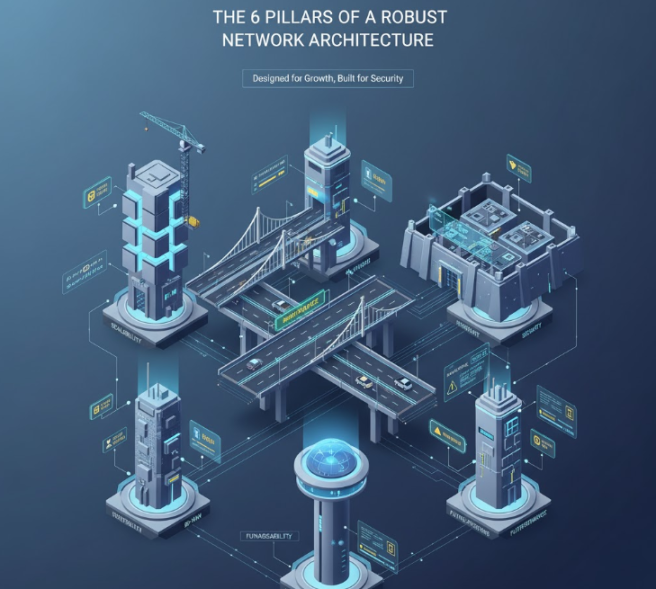
Core Principles of a Strong Network Architecture
- Scalability
- Networks should handle growth in users, devices, and data without requiring a complete overhaul.
- Use modular designs, such as spine-leaf architectures, to ensure smooth expansion.
- Redundancy and Reliability
- Implement failover systems and multiple pathways to avoid single points of failure.
- Consider redundant switches, routers, and backup links to maintain uptime.
- Security by Design
- Integrate network security at every layer, including firewalls, segmentation, and access controls.
- Leverage zero-trust models and Network Access Control (NAC) solutions to protect enterprise resources.
- Performance Optimization
- Prioritize traffic based on critical applications and use Quality of Service (QoS) policies.
- Regularly monitor network health to identify bottlenecks.
- Manageability and Automation
- Simplify network operations with centralized management tools.
- Utilize AI-driven monitoring and automated provisioning to reduce manual errors.
- Future-Proofing
- Plan for emerging technologies like 5G, IoT, and AI integration.
- Ensure the network can support new applications without significant redesign.
Best Practices for Enterprise Network Design
- Conduct a network audit before upgrades or expansion.
- Use layered network architecture (core, distribution, access) to optimize traffic flow.
- Implement software-defined networking (SDN) for flexibility.
- Incorporate network segmentation to limit security breaches.
- Maintain comprehensive documentation for all network components.
FAQs
Q1: What is the difference between a scalable and non-scalable network?
A scalable network can grow seamlessly as users, devices, and applications increase, while a non-scalable network requires major redesigns to accommodate growth.
Q2: How does redundancy improve network reliability?
Redundancy provides backup paths and devices, ensuring that network failures do not disrupt business operations.
Q3: Why is security integral to network architecture?
Integrating security from the ground up protects data, prevents breaches, and supports compliance requirements.
Q4: What role does automation play in modern networks?
Automation reduces human error, speeds up deployment, and enables real-time monitoring for proactive issue resolution.
Q5: How often should enterprises review their network architecture?
At least annually, or whenever significant changes in technology, user load, or security requirements occur.
Q6: Can OmniLegion assist in designing a network architecture?
Yes, OmniLegion provides expert IT talent and advisory services to build secure, scalable, and future-proof enterprise networks.
Conclusion
Partner with OmniLegion to evaluate your network, design scalable solutions, and access top IT talent for implementation. Learn more about our engineering opportunities and case studies for insights into enterprise network success.