
Introduction
In today’s enterprise IT landscape, companies increasingly adopt hybrid cloud architectures to balance performance, cost, and security. Yet, connecting on-premises systems with multiple cloud providers can be complex. Understanding hybrid cloud networking is critical for CIOs, CTOs, and operations leaders aiming for seamless cloud integration.
Understanding Hybrid Cloud Networking
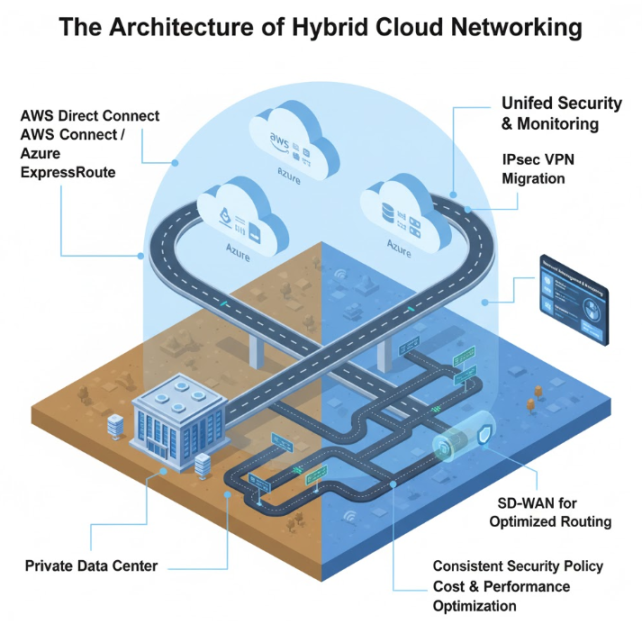
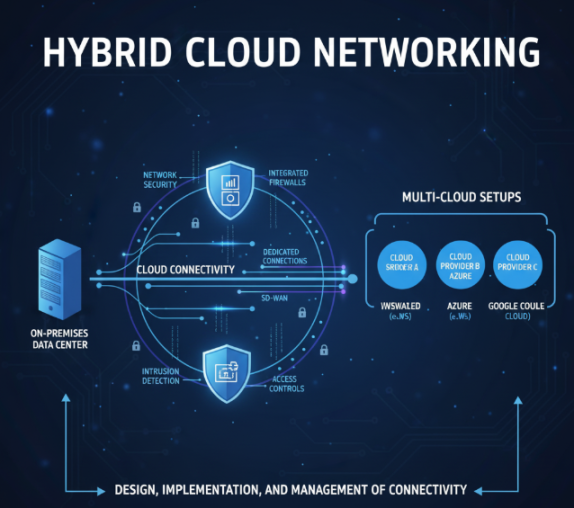
Hybrid cloud networking refers to the design, implementation, and management of connectivity between private data centers and public cloud platforms. It enables organizations to extend their existing infrastructure while leveraging cloud scalability and flexibility.
Key components include:
- Cloud Connectivity: Secure VPNs, dedicated connections (e.g., AWS Direct Connect, Azure ExpressRoute), and SD-WAN for optimized traffic.
- Multi-Cloud Setups: Coordinating workloads across multiple cloud providers while maintaining consistent performance, security, and compliance.
- Network Security: Integrated firewalls, intrusion detection, and access controls to protect data in transit.
Best Practices for Hybrid Cloud Networking
Implementing hybrid cloud networks requires careful planning and ongoing management. Best practices include:
- Assess Workload Requirements: Determine which applications are best suited for public cloud vs. on-premises.
- Leverage SD-WAN: Simplify connectivity, improve latency, and enhance traffic management across sites and clouds.
- Implement Consistent Security Policies: Ensure encryption, access control, and monitoring are applied across all environments.
- Monitor Performance: Use network monitoring tools to track traffic, bandwidth usage, and application response times.
- Plan for Scalability: Design networks that can adapt to growing cloud adoption and future multi-cloud expansions.
Frameworks and Tools
A structured approach can simplify hybrid cloud networking:
| Step | Action |
|---|---|
| 1 | Map existing on-premises network and workloads |
| 2 | Identify cloud providers and connectivity options |
| 3 | Define security and compliance requirements |
| 4 | Implement SD-WAN or VPN for cloud integration |
| 5 | Continuously monitor and optimize network performance |
Tools like OmniLegion’s IT consulting services and case studies on multi-cloud deployments provide real-world insights for enterprises.
FAQs
1. What is the difference between hybrid and multi-cloud networking?
Hybrid cloud combines on-premises infrastructure with public cloud, while multi-cloud uses multiple cloud providers without necessarily involving on-premises systems.
2. How does SD-WAN improve hybrid cloud performance?
SD-WAN dynamically routes traffic, optimizes bandwidth, and enhances connectivity between sites and cloud platforms.
3. Is hybrid cloud networking secure?
Yes, when combined with encryption, firewalls, and access controls that protect data in transit and at rest.
4. What are common challenges with hybrid cloud networking?
Complex routing, latency, inconsistent security policies, and limited visibility are key challenges.
5. How can companies ensure compliance in hybrid cloud setups?
By standardizing security policies, auditing traffic, and using monitoring tools to enforce compliance across all networks.
6. Why should enterprises work with a trusted IT partner?
A partner like OmniLegion provides expertise in cloud connectivity, multi-cloud strategy, and secure network design.
Conclusion
Hybrid cloud networking is essential for modern enterprise IT, providing flexibility, scalability, and secure access across on-premises and cloud environments. Enterprises looking to optimize connectivity and implement best practices can benefit from partnering with OmniLegion’s experienced IT advisors.