
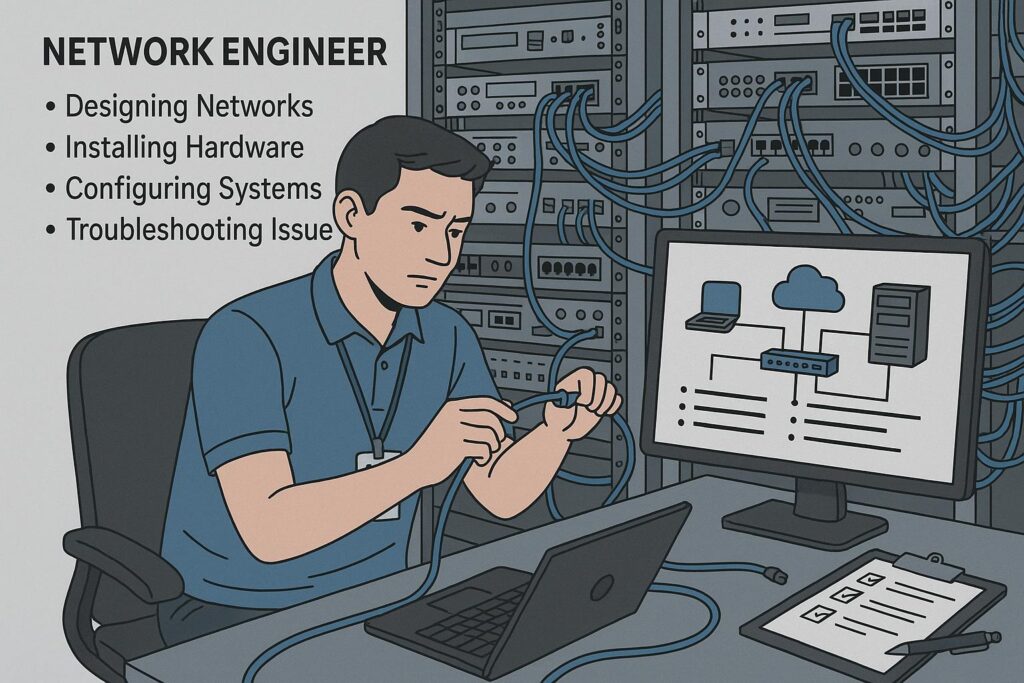
What Does a Network Engineer Actually Do?
Meta description: Explain the day-to-day role of network engineers and why they matter in modern business infrastructure.
Ever had your productivity grind to a halt because of a network outage, lagging video calls, or sporadic system downtimes? In today’s AI-powered, hyper-connected workplaces, seamless digital communication is non-negotiable. But what keeps the gears turning behind the scenes? Enter the network engineer—a crucial, yet often unsung, hero of modern business infrastructure.
Understanding the Network Engineer Role
A network engineer designs, implements, and maintains the backbone of a company’s digital operations: its network. With the rise of cloud platforms, remote teams, and AI-powered workflows, network engineer responsibilities are more vital than ever. Their work ensures your data moves securely, quickly, and reliably between employees, devices, and applications.
Key Network Engineer Responsibilities
- Design and Architecture: Planning efficient network layouts that support business growth and scalability.
- Implementation: Setting up routers, switches, firewalls, and wireless access points to create a secure, resilient network.
- Monitoring and Maintenance: Using advanced tools (often with AI) to detect outages, bottlenecks, or suspicious activity before it impacts productivity.
- Troubleshooting: Diagnosing and resolving issues—from slow Wi-Fi to complex security vulnerabilities.
- Security Management: Configuring robust access controls and monitoring for threats to protect sensitive business data.
How Network Engineers Boost Productivity
Network engineers don’t just keep the lights on—they actively empower teams to work smarter. Here’s how:
| Challenge | Network Engineer Solution | Impact |
|---|---|---|
| Unreliable connections | Optimize traffic routing, upgrade hardware | Faster file sharing, fewer interruptions |
| Security threats | Deploy firewalls, intrusion detection systems | Protects data, maintains compliance |
| Remote collaboration | Set up VPNs, secure remote access | Enables hybrid and remote work |
For professionals working with AI workflows or prompt engineering, a robust network is essential for handling large datasets, real-time collaboration, and the seamless integration of new tools. If you’re looking to level up your AI productivity, don’t overlook the network layer.
Prompt Engineering Meets Network Engineering
Prompts and AI models can only be as fast and reliable as the networks that connect them. For example, when deploying large language models, a network engineer can:
- Ensure low-latency connections to cloud AI services
- Implement segmented networks to safeguard sensitive data
- Monitor bandwidth usage to prevent slowdowns during peak hours
By collaborating with IT, prompt engineers and AI specialists can build workflows that are both innovative and dependable.
FAQ: Network Engineer Role & Responsibilities
What does a network engineer do on a daily basis?
They monitor network performance, troubleshoot issues, update configurations, and ensure secure, efficient connectivity for all users.
Why are network engineer responsibilities critical for businesses?
Network engineers protect against downtime, cyber threats, and inefficiencies that can disrupt productivity and compromise business data.
How do network engineers support AI and modern workflows?
They optimize networks for the bandwidth and security demands of AI tools, ensuring seamless integration and real-time performance.
What skills should a network engineer have?
Technical expertise in networking protocols, security, troubleshooting, and increasingly, knowledge of automation and AI-driven monitoring tools.
Can prompt engineering benefit from strong network infrastructure?
Absolutely. Reliable, high-speed networks are essential for testing, training, and deploying advanced AI models and prompt frameworks.
Explore More with Omni Legion
If you’re ready to unlock the full potential of your AI and productivity stack, consider how your network foundation supports your goals. Explore Omni Legion’s services to future-proof your business infrastructure and empower your team with next-level workflows.
For deeper insights, check out trusted resources from Cisco or CompTIA.