
9 Questions to Ask Before Consolidating IT Vendors
For many growing businesses, managing multiple IT vendors can feel like juggling too many balls at once—each with its own contracts, points of contact, and levels of service. Vendor consolidation promises to simplify operations and cut costs, but it can also introduce new risks if not handled carefully. Before you make the leap, it’s essential to ask the right questions before consolidating IT vendors to ensure your move streamlines processes without compromising security or performance.
Why IT Vendor Consolidation Matters for SMBs
Consolidation can lead to better pricing, simplified management, and improved service quality. However, the wrong approach can create single points of failure, reduce negotiating power, and leave gaps in your security posture. To help you evaluate your options, we’ve compiled a practical checklist for assessing IT vendor consolidation—tailored for business owners, IT directors, and operations leaders.
Checklist: 9 Essential Questions Before Consolidating IT Vendors
-
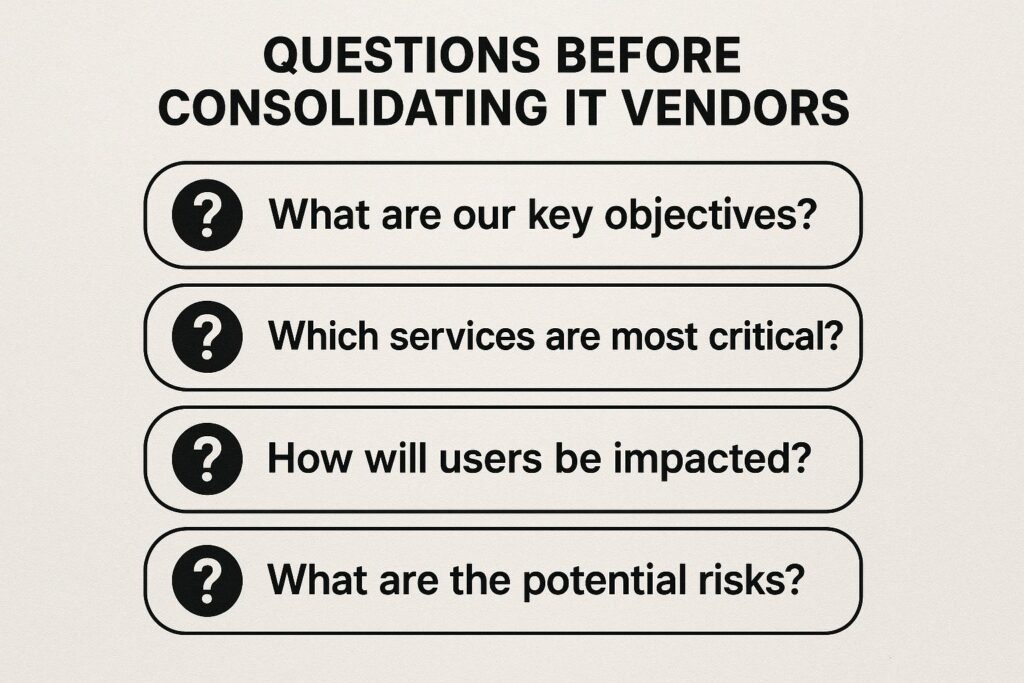
What business goals are driving consolidation?
Define what you hope to achieve—cost savings, improved security, better support, or scalability. Clear objectives guide your RFPs and negotiations. -
How will consolidation impact current workflows and operations?
Map out dependencies between vendors and internal teams. Will your staff need retraining? Are there mission-critical systems involved? -
Which vendors demonstrate proven expertise across your required domains?
Evaluate candidates not just on price but on their track record in managed services, cybersecurity, and cloud. -
What are the potential risks of reducing vendor diversity?
Consider resiliency: Will a single vendor create operational or security bottlenecks? Reference Gartner’s vendor management best practices for additional guidance. -
How will data security, privacy, and compliance be maintained?
Insist on documented controls for sensitive data, especially if your industry faces strict compliance requirements. -
What service level agreements (SLAs) and escalation paths will be in place?
Ensure clear SLAs, response times, and escalation processes are included in contracts to avoid future ambiguity. -
Can the consolidated vendor scale with your business?
Assess whether your vendor’s capabilities align with your growth plans and evolving technology needs. -
What is the total cost of ownership (TCO), including hidden costs?
Go beyond headline pricing. Factor in transition costs, integration, and potential productivity impacts. -
How will the transition be managed and supported?
Request a detailed migration plan. A trusted advisor like Omni Legion can help oversee transitions and mitigate risks.
Frameworks for Smarter IT Vendor Decisions
- RFP Template: Specify business objectives, technical requirements, security standards, and expected outcomes.
- Vendor Scorecard: Rate vendors on expertise, coverage, support, compliance, and cultural fit.
- Risk Assessment Checklist: Identify potential single points of failure, data risks, and support gaps.
For more on structuring these frameworks, see the CIO guide to vendor management.
FAQ: Questions About Consolidating IT Vendors
- What are the main benefits of IT vendor consolidation?
- Benefits include simplified vendor management, cost savings, and stronger relationships. However, careful evaluation is key to avoid new risks.
- How can SMBs minimize risk during vendor consolidation?
- Start with a thorough needs assessment, use a structured RFP process, and work with an experienced advisor such as Omni Legion.
- What should be included in a vendor consolidation RFP?
- Business goals, technical requirements, security and compliance standards, service levels, and transition expectations.
- How does vendor consolidation impact cybersecurity?
- While fewer vendors can improve oversight, it may create single points of failure. Ensure robust security controls and regular audits.
- Is it ever better to keep multiple IT vendors?
- Yes—especially for specialized needs or when redundancy is critical. Each scenario should be evaluated on its own merits.
Need Guidance on IT Vendor Consolidation?
Consolidating IT vendors can streamline your operations—but only with careful planning and expert guidance. If you’re considering this step, contact Omni Legion for tailored IT advisory and risk assessment. We help SMBs build secure, scalable technology foundations that support business growth.