
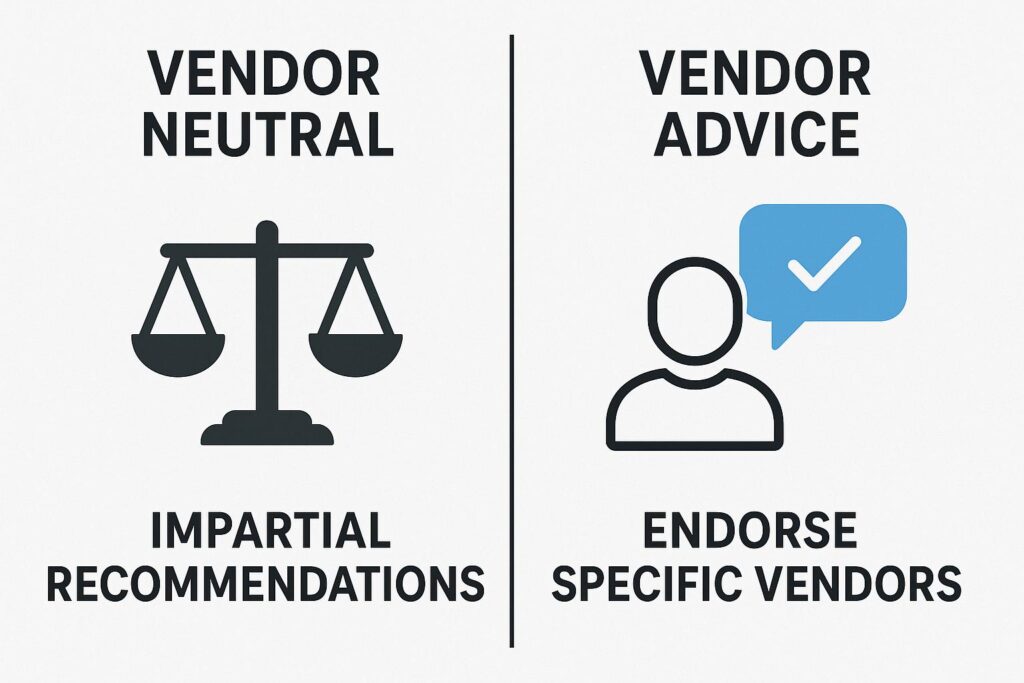
Top 5 Reasons Vendor-Neutral Advice Beats Vendor-Provided Advice
When selecting new technology or managed services, many business leaders face a familiar dilemma: should you trust the advice of a vendor, or seek independent, vendor-neutral guidance? The difference between vendor neutral vs vendor advice can have long-term implications for your organization’s IT strategy, costs, and security. At Omni Legion, we’ve seen firsthand how objective technology advisory can help small and mid-sized businesses (SMBs) make smarter, lower-risk decisions.
Why Vendor-Neutral Advice Matters for IT Decisions
Vendor advice is often shaped by sales targets and product portfolios. In contrast, vendor-neutral advisors have no stake in which solution you choose. Here’s why that matters:
1. Avoiding Conflicts of Interest
- Vendor advice: Often tied to commission or quotas, leading to biased recommendations.
- Vendor-neutral advisors: Evaluate your needs first, free from product or platform bias.
This objectivity is especially important for major investments like managed IT services or cybersecurity solutions. Learn how Omni Legion maintains true independence in our advisory services.
2. Comprehensive Solution Scoping
- Vendor reps may only propose solutions from their catalog.
- Independent advisors consider a broader range of technologies and providers.
This means you’ll receive recommendations that fit your business requirements, not just what a single vendor can deliver.
3. Greater Transparency During RFPs
- Vendor-neutral partners help you write unbiased RFPs and compare bids apples-to-apples.
- They can flag hidden costs, contract lock-ins, or missing features before you commit.
For practical RFP frameworks, see our Vendor Selection Framework.
4. Reduced Technology Risk
- Vendor-agnostic guidance helps you avoid single-vendor dependence.
- It’s easier to adapt, integrate, or switch providers as your needs evolve.
The National Institute of Standards and Technology (NIST) recommends a multi-vendor approach to improve security and resilience (NIST SP 800-53).
5. Ongoing Support and Accountability
- Independent advisors advocate for your interests during implementation and support.
- They’re invested in your success—not just the initial sale.
This means a higher level of service and trust as your business grows.
Actionable Tips: How to Evaluate Vendor Neutral vs Vendor Advice
- Ask if the advisor receives incentives from any vendor.
- Request a comparison of at least three solutions.
- Insist on transparent evaluation criteria and scoring.
- Review references from similar organizations.
FAQ: Vendor-Neutral vs Vendor Advice
- What is vendor-neutral advice in IT?
- Vendor-neutral advice means recommendations are based solely on your needs, without financial ties or obligations to any technology provider.
- Why is vendor-neutral advice important for SMBs?
- It helps SMBs avoid biased recommendations, reduces lock-in risk, and ensures solutions fit your unique requirements.
- How can I tell if an advisor is truly vendor-neutral?
- Ask about their compensation model, partnerships, and whether they disclose all incentives or affiliations.
- Should I always avoid vendor advice?
- Vendor reps can provide useful product info, but decisions should be validated by an independent advisor for objectivity.
- Can Omni Legion help with vendor selection?
- Yes. Omni Legion offers technology advisory and vendor selection services to guide your IT decisions with transparency and expertise.
- Where can I learn more about unbiased IT strategy?
- Refer to trusted sources like Gartner’s vendor-neutral definition.
Ready for Objective IT Advice?
Choosing the right IT solutions shouldn’t be left to chance or sales pressure. If you want truly vendor-neutral guidance for your next technology project, contact Omni Legion today. Our team is here to help you make confident, informed decisions that support your business goals.