
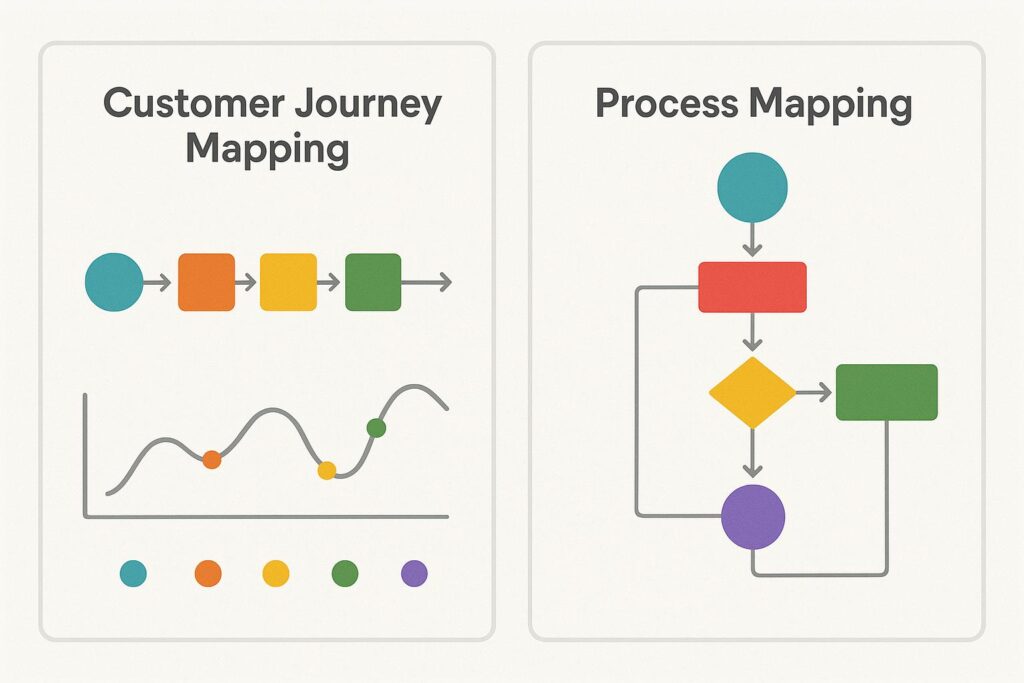
Customer Journey Mapping vs Process Mapping: What’s the Difference?
When teams aim to boost productivity or implement AI solutions, understanding customer journey mapping vs process mapping can make or break your strategy. Both tools help visualize and improve workflows, but they’re tailored for different goals. So—how do you know which to use, and when? Let’s break down the differences, best practices, and practical tips to help you use prompts and frameworks more strategically.
Why Distinguishing Between Journey and Process Mapping Matters
Imagine you’re rolling out a new AI-driven customer support tool. Should you map out the customer’s experience, or focus on your team’s internal workflow? Choosing the right approach saves time, clarifies responsibilities, and ensures your prompt engineering efforts actually solve the right problem.
- Customer Journey Mapping: Focuses on the customer’s experience from first contact to post-purchase—ideal for identifying friction points and optimizing touchpoints.
- Process Mapping: Zeroes in on your internal operations, visualizing each step your team takes to complete a task or service.
Key Differences: Customer Journey Mapping vs Process Mapping
| Aspect | Customer Journey Mapping | Process Mapping |
|---|---|---|
| Focus | Customer’s perspective | Internal workflow |
| Goal | Enhance customer experience | Increase efficiency & quality |
| Common Use Cases | Onboarding, support, retention | Order fulfillment, approvals, incident response |
| Key Questions | How does the customer feel at each stage? | What steps are required? Who is responsible? |
When to Use Each Mapping Approach
Use customer journey mapping when you want to:
- Spot pain points in the customer experience
- Inform AI prompt design for personalized interactions
- Align teams around customer-centric goals
Use process mapping when you need to:
- Streamline workflows or automate repetitive tasks
- Clarify roles, handoffs, and dependencies
- Identify opportunities for AI-powered process improvements
Pro Tip: Combining Both for Maximum Impact
The best teams often start with a journey map to empathize with customers, then layer in process maps to optimize the behind-the-scenes work. This dual approach is especially powerful when designing AI prompts or automations that span both customer-facing and internal processes. For further guidance, see our Prompt Engineering for Business guide and AI Productivity Frameworks article.
FAQ: Customer Journey Mapping vs Process Mapping
- What is the main difference between customer journey mapping and process mapping?
- Customer journey mapping focuses on the end-to-end customer experience, while process mapping details the internal steps your team takes to deliver a product or service.
- Can I use both mapping methods together?
- Absolutely. Combining both methods helps you build a seamless customer experience while improving internal efficiency—especially when integrating AI solutions.
- How does journey mapping benefit prompt engineering?
- Mapping the customer journey helps you design prompts that feel more natural and personalized, improving user satisfaction with AI-driven tools.
- What tools can help with mapping?
- Popular tools include Miro, Lucidchart, and Smaply (Nielsen Norman Group). For AI-specific mapping, consider frameworks like those shared by Gartner.
- How often should I update my maps?
- Review and update your maps quarterly or whenever you launch new products, processes, or AI features.
Ready to Map Smarter?
Understanding customer journey mapping vs process mapping is just the first step. For more insights and expert frameworks, explore AI Productivity Frameworks or connect with Omni Legion’s team to unlock the full potential of AI and prompt engineering in your business.